
Every property manager knows the feeling. A resident calls the office frustrated because their gate remote died again. A guest is stuck outside the community entrance with no way in. A stack of unreturned key fobs sits in a drawer, each one representing a security gap and an unrecovered cost.
These are not edge cases. They are daily realities at garden style apartments across the country. According to the NMHC and Grace Hill 2024 Renter Preferences Survey of more than 172,000 verified renters, 85% reported enjoying living in their communities, and the survey found that residents increasingly seek value-rich environments where everyday conveniences work as expected. When your access control system creates friction instead of convenience, it shows up in satisfaction scores, renewal rates, and ultimately your bottom line.
This is the story of two Houston-area communities that faced these exact problems and solved them within 90 days.
Garden style apartments present unique access control challenges. Sprawling layouts mean multiple gates, amenity buildings, mail centers, and pedestrian access points, all of which need reliable, coordinated management. Traditional systems rely on physical credentials like key fobs, gate remotes, and PIN codes that were designed for a simpler era.
The costs add up quickly. Key fobs for apartment communities typically run between $50 and $100 each, but the sticker price only tells part of the story. When you factor in programming, replacement shipping, battery failures, and the staff time required to manage it all, the total cost per key fob replacement incident averages $107. Multiply that across hundreds of units and a full year of turnover, and you have a significant line item that many property managers never properly track.
Beyond the financial drain, outdated access control systems create operational headaches that ripple across your team. Tracking which fob belongs to which resident, deactivating credentials after move-outs, troubleshooting malfunctions, and fielding resident complaints all consume hours that should go toward leasing, community engagement, and retention.
Two communities decided enough was enough.
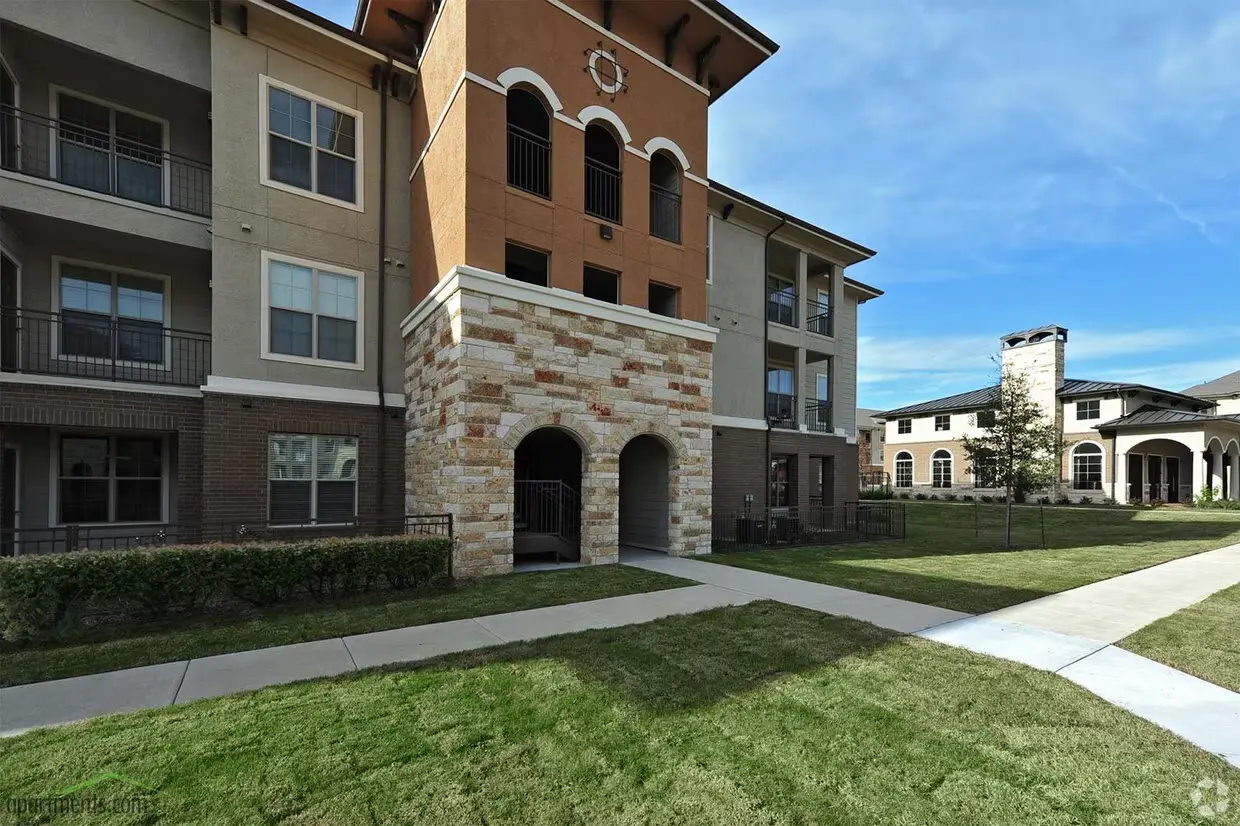
Vue Castle Hills is a garden style apartment community in Lewisville, Texas, serving more than 200 residents. Shon Flowers, the Community Manager, brings 18 years of property management experience and a passion for creating positive experiences for residents, prospects, and ownership alike.
Before switching to a modern access control system, the team at Vue Castle Hills was dealing with three persistent problems: the high and ongoing cost of gate remotes (including repair needs and battery failures), limited and inconvenient guest access to controlled-entry gates, the fitness center, and the mail center, and outdated software that lacked the functionality and reliability the team needed.
The combination of these issues created what Shon described as unnecessary friction for residents and guests, while placing a financial and operational burden on the property.
After implementing Gatewise's smartphone-based gate access control platform, the results came quickly. Within approximately three months, Vue Castle Hills significantly reduced issues related to remote controls. The mobile app replaced physical credentials entirely, giving residents and their guests a more convenient, modern way to manage access. Corporate and ownership stakeholders also gained the ability to download the app and access the community as needed, improving visibility and flexibility.
"We've significantly reduced issues related to remote controls, including repair needs and battery failures, which has helped lower costs and minimize maintenance requests," Shon Flowers shared.
The switch also addressed the guest access problem. Where visitors previously faced friction at controlled-entry gates, the fitness center, and the mail center, the mobile platform provided a seamless, user-friendly experience. Residents responded positively and continue to applaud the change.
Read the full Vue Castle Hills success story →
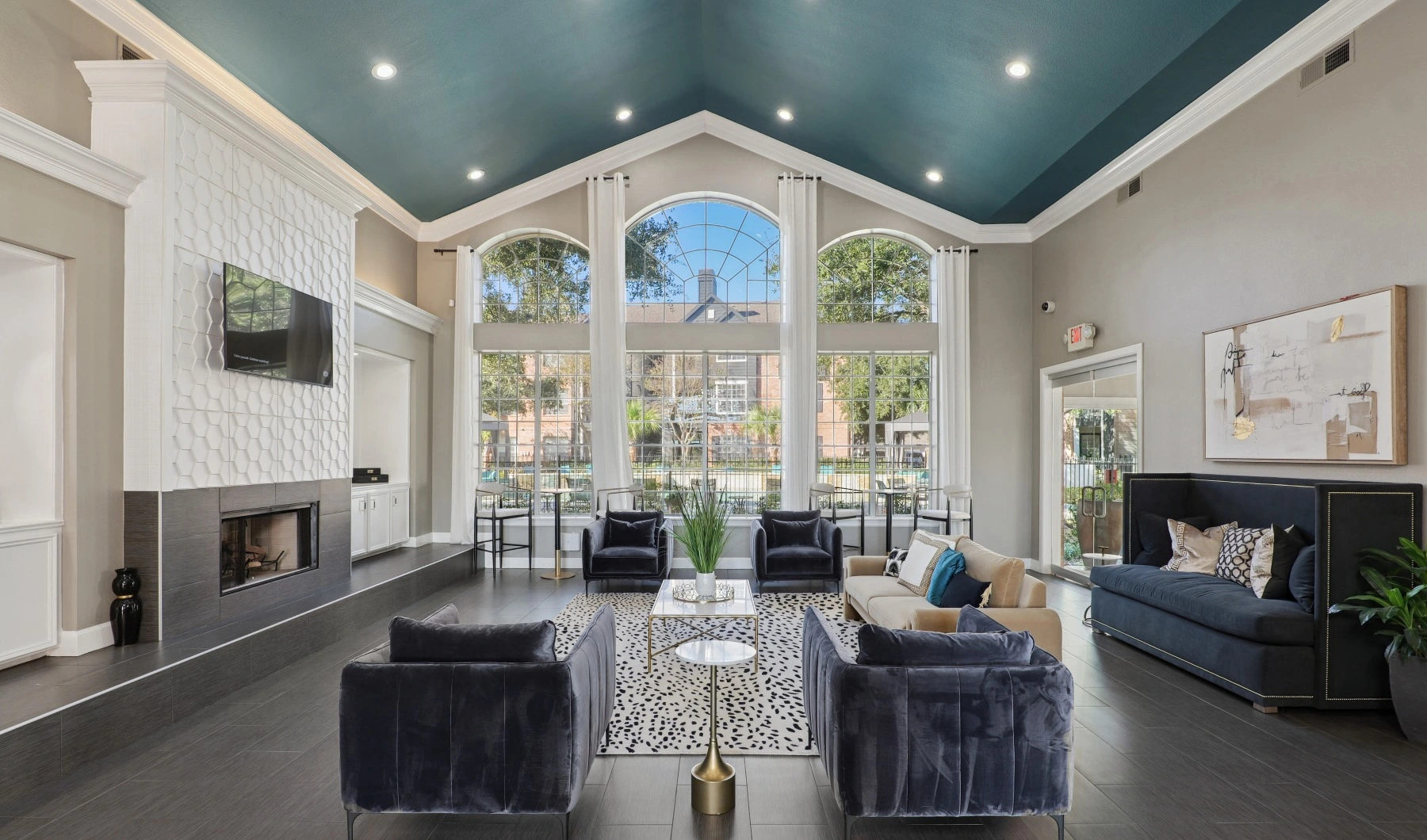
Across town, Kairoi Residential's Stonewood community was battling a different but equally frustrating version of the same problem. Jessica Torrez, the Community Director with approximately eight years of industry experience, leads a garden style apartment community of more than 200 residents in Houston.
The community's traditional key fob system was unreliable, and that unreliability had a cascading effect. Malfunctioning fobs meant residents could not count on smooth entry to their own community, leading to repeated complaints and maintenance requests that drained staff time. The guest access situation was even worse: when visitors arrived and could not get through the gate, residents had to leave what they were doing to physically escort them in, eroding the very convenience a gated community is supposed to provide.
After switching to Gatewise, the Kairoi Residential community completely transitioned away from its unreliable key fob system within three months. Smartphone-based access replaced the fobs that had been a persistent source of frustration, delivering consistent, dependable entry for every resident. Entry-related complaints dropped significantly, and residents now grant guest access with a single tap in the app.
"Since implementing Gatewise, we've seen improved reliability with access control, fewer entry-related complaints, and a smoother experience for both residents and their guests. The system has reduced operational headaches and increased overall resident satisfaction," Jessica Torrez reported.
The installation was fast and straightforward. As Gatewise's case study notes, the system installs in days, not weeks, with cellular-based hardware that requires no complex internet setup at each access point.
Read the full Kairoi Residential (Stonewood) success story →
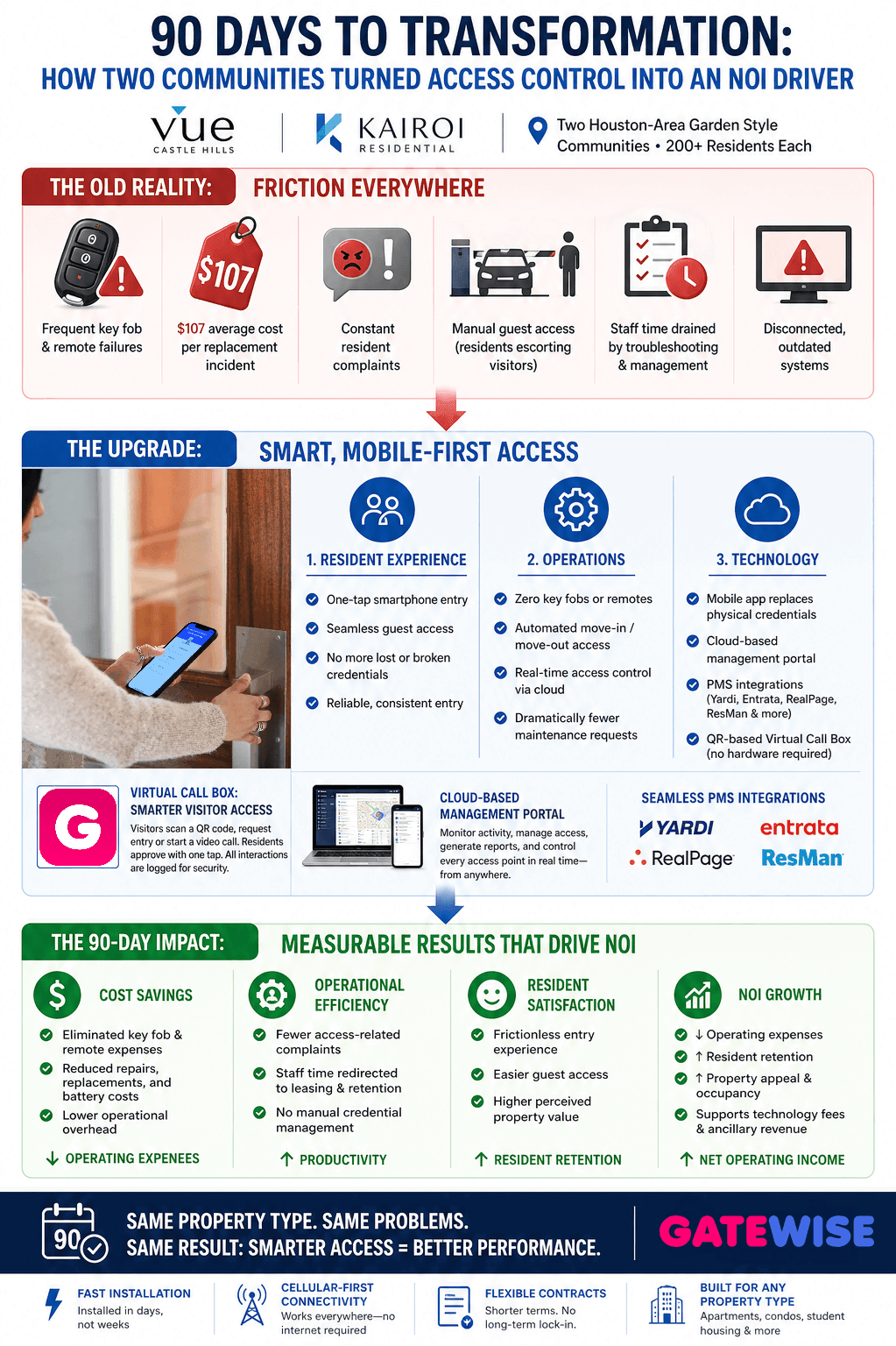
Both Vue Castle Hills and Kairoi Residential are garden style communities with more than 200 residents in the Houston metro. Both dealt with legacy credential systems that drained budgets and frustrated everyone involved. And both saw measurable improvements within 90 days of switching. The common thread was not just a new vendor. It was a fundamentally different approach to access control technology.
The most immediate change at both communities was the elimination of physical key fobs and gate remotes. Residents download the Gatewise mobile app and receive instant access to every controlled entry point in their community, from vehicle gates to amenity spaces. Lost phone? Access transfers to the new device in minutes without involving staff.
This is a significant shift from the traditional model, where every move-in requires a fob handoff, every move-out requires collection and deactivation, and every lost credential triggers a replacement cycle. Whether you manage a condo or an apartment community, the operational savings of eliminating physical credentials compound quickly.

Both communities now manage all access points through Gatewise's cloud-based management portal. Property teams can monitor gate activity in real time, generate access reports, onboard new residents with a few clicks, and automatically remove access for move-outs.
For regional managers overseeing multiple properties, this centralized visibility is particularly valuable. Instead of relying on individual property teams to report status, a regional manager can log in and see real-time operational data across their entire portfolio, the kind of capability that matters when evaluating the best building management system for access across diverse property types.
One of the most overlooked pain points in gated communities is visitor access. Traditional intercom systems and call boxes require expensive hardware, ongoing maintenance, and often frustrate both residents and their guests. Gatewise's Virtual Call Box takes a different approach: visitors scan a QR code at the gate entrance, select the resident they are visiting from a directory, and either request entry or initiate a video call, all from their own smartphone. No app download required.
The resident receives a push notification, approves or denies the request, and the gate opens. The entire interaction is logged for security. And the best part? The Virtual Call Box is completely free for all Gatewise customers, with no additional hardware required. Setup takes minutes: just print and post the provided QR code PDF at your entrance. Compared to the cost of installing and maintaining a traditional intercom system or physical call box, the savings are substantial.
Both case studies highlight one of Gatewise's most operationally significant features: deep integrations with leading property management software platforms including Yardi, RealPage, Entrata, and ResMan. When a lease ends in your property management system, access is automatically revoked. When a new resident moves in, access is provisioned without manual data entry.
This kind of seamless connectivity is what separates a functional apartment security system from a truly integrated access control solution. If you are evaluating a property management system comparison or looking for the best property management software for your portfolio, the ability to automatically sync access credentials with your PMS should be near the top of your requirements list.
For property owners and regional managers, every technology decision ultimately comes back to one question: how does this affect net operating income?
So what is NOI in real estate? Net operating income is the total revenue a property generates minus all operating expenses, excluding debt service and capital expenditures. The net operating income formula is straightforward: total revenue minus operating expenses equals NOI. NOI meaning in real estate is simple: it is the single most important metric for evaluating a property's financial performance, and it drives property valuation, lending decisions, and investment returns.
Access control systems impact NOI on both sides of the equation. On the revenue side, modern access control technology enhances property appeal, supports higher occupancy rates, and can justify technology fees that create ancillary revenue. On the expense side, eliminating key fob and gate remote costs, reducing maintenance requests, freeing up staff time, and automating move-in and move-out access management all lower operating expenses.
Vue Castle Hills saw direct cost reductions from eliminating gate remote purchases, repairs, and battery replacements. Kairoi Residential freed up staff time that had been consumed by access-related complaints and manual guest entry. In both cases, the switch improved the resident experience, a factor that contributes to lease renewals and higher occupancy, which in turn drives revenue and protects net operating income.

If these case studies sound familiar, you are probably evaluating access control solutions for your own properties. The market for access control systems is crowded, with options ranging from traditional key fob systems to fingerprint door locks, security camera installations, and comprehensive smart access platforms. Here is what to prioritize when choosing the best access control systems for multifamily communities.
Connectivity that works everywhere. Garden style apartments often have access points far from the leasing office and without reliable internet or hardwired connections. Systems that depend on Wi-Fi at each gate create single points of failure and may require costly infrastructure like an uninterruptible power supply at every access point. Cellular-first connectivity, the approach used by Gatewise, eliminates this dependency entirely. The hardware communicates over cellular networks, meaning even access points at the far edges of a sprawling property work reliably without internet, complex wiring, or garage door opener repair-style troubleshooting for aging gate equipment.
Mobile-first design. Residents in both apartments and condos expect smartphone-based access. The days of handing out physical credentials are fading. A mobile access control system should support resident entry, guest key sharing, and amenity access, all from a single app.
Property management software integration. Any access control system you choose should integrate directly with your PMS. If it does not connect to Yardi, RealPage, Entrata, or ResMan, you will end up with manual processes that undermine the efficiency gains you are trying to achieve.
Flexible contracts. Legacy access control manufacturers often lock properties into multi-year agreements. Look for providers that offer shorter commitment terms, so you can evaluate performance without being locked in.
Scalability across property types. Whether you manage garden style apartments, mixed-use properties, student housing, or senior communities, your access control solution should flex to meet different property types and configurations. The ability to add features like self-guided tours for prospective residents conducting a virtual apartment tour of your community adds leasing value on top of operational efficiency.
Fast installation. Systems that take weeks to install mean weeks of disruption. Both Vue Castle Hills and Kairoi Residential were up and running in days, with minimal impact on daily operations.
The stories of Vue Castle Hills and Kairoi Residential are not outliers. They represent a pattern playing out at garden style apartment communities across the country: legacy access control systems creating unnecessary costs, frustrating residents, and dragging down operational efficiency, followed by a switch to modern, smartphone-based access control that delivers measurable improvements within 90 days.
Both communities reduced costs. Both eliminated persistent credential failures. Both improved resident satisfaction. And both did it without lengthy installations, complex infrastructure projects, or multi-year contract commitments.
If you are facing similar challenges at your properties, the path forward is clear. Schedule a free consultation to discuss how Gatewise can transform your communities, or explore both case studies to see the full results:
Ready to calculate the potential impact on your portfolio? Try the Gatewise ROI Calculator to see what eliminating key fob costs and streamlining access management could mean for your net operating income.
Gatewise offers a simple and modern gate entry system that provides residents with a mobile app and managers with a cloud-based management portal.