With the U.S. now home to over 52,000 self-storage facilities and new construction spending reaching a record $7.4 billion in 2023, competition has never been fiercer. The facilities that thrive will be those that deliver the seamless, mobile-first experience today's renters expect—not the ones scrambling to retrofit outdated keypads after opening day.
This guide walks developers and owners through the critical decisions that separate smart access control investments from expensive mistakes.

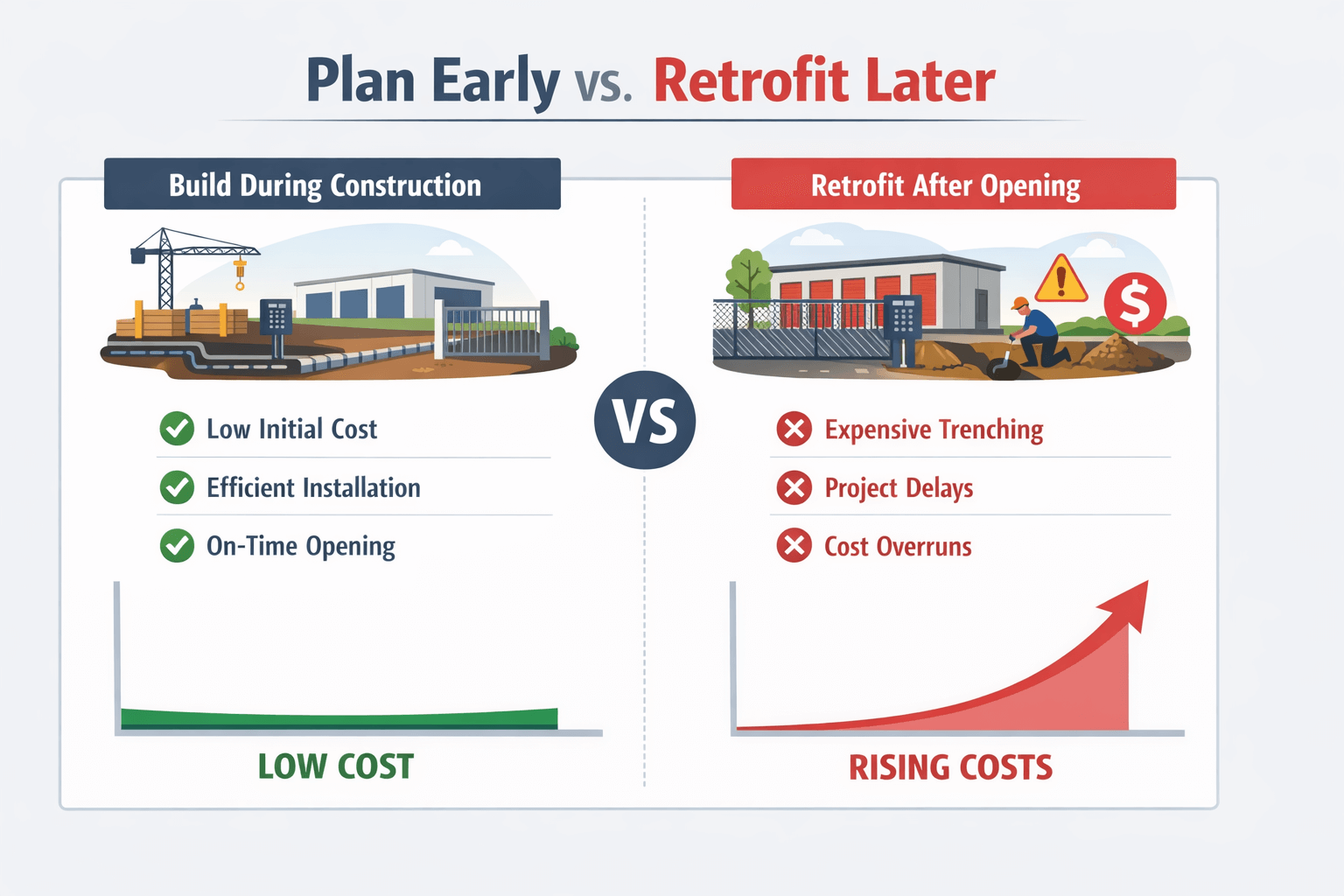
The economics are simple: designing access control systems into new construction costs a fraction of retrofitting them later. According to Inside Self Storage, incomplete access control specifications can lead to hundreds of thousands of dollars in cost overruns. Common mistakes include failing to specify access control as a contractor responsibility, installing keypads before gates (requiring costly repositioning), and choosing one-way keypads that can't track how long tenants remain on-site.
Traditional access control system installations run $1,200 to $2,500 per door, according to Kisi's 2025 cost analysis. Gate access control systems for facility perimeters typically add $3,000 to $6,000. When you factor in the trenching, conduit runs, and network infrastructure that new construction allows you to install efficiently, the case for planning early becomes overwhelming.
The alternative—running cables through finished buildings, tearing up landscaping, or settling for wireless retrofits that compromise functionality—erodes both your budget and your competitive position before you've collected your first month's rent.
The demographics driving self-storage demand have shifted dramatically. According to StorageCafe's 2025 industry analysis, Millennials now represent 25% of self-storage renters—up from 21% in 2023—making them the fastest-growing demographic in the industry. Combined with Gen Z at 10%, younger generations now comprise 35% of all renters.
These digital natives don't compare your facility to the storage place down the street. They benchmark their experience against the frictionless apps they use for ridesharing, food delivery, and banking. A SpareFoot survey found that 63% of self-storage customers now prefer mobile apps for booking, payments, and access. Meanwhile, Storable's 2024 Tenant Insights Report reports that more than one-third of customers consider technology "very important" when choosing a facility.
Perhaps most telling: 23% of Millennials not currently renting storage intend to rent in the future—the highest intent rate of any generation. The facilities capturing this growing market will be those offering 24/7 mobile access and contactless entry, not the ones asking customers to memorize PIN codes or carry key fobs.
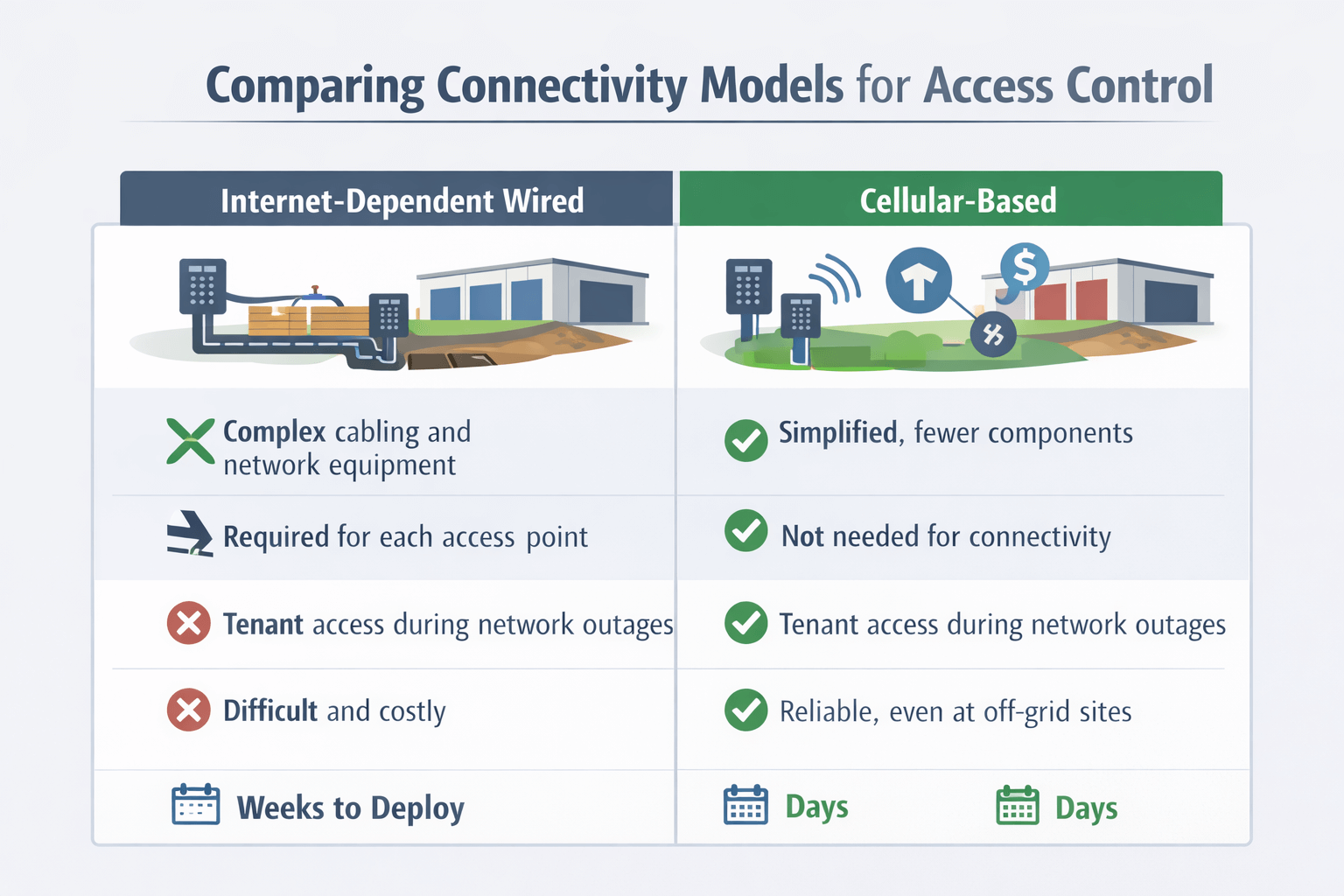
Most commercial access control systems assume reliable internet connectivity—an assumption that breaks down quickly in self-storage environments. Sprawling outdoor facilities, remote locations, and the cost of running network infrastructure to every gate and building entrance make traditional wired solutions impractical for many operators.
Cellular-based access control systems operate independently of facility infrastructure, communicating via 4G LTE or 5G networks rather than requiring CAT5/CAT6 cabling to every access point. This architecture offers several advantages for new construction:
For developers evaluating access control solutions, the connectivity question often determines whether a facility can offer true 24/7 unmanned operation or will require on-site staff to handle access issues when systems go down. Solutions like Gatewise, which use cellular connectivity with Bluetooth backup, ensure tenants can always access their units regardless of network conditions.
Gate selection affects everything from site layout to ongoing maintenance costs. The three primary gate types each suit different facility configurations:
Slide gates move horizontally along a track, making them ideal for facilities with limited depth but adequate width. They handle heavy traffic well and work in most weather conditions, though track maintenance becomes a recurring expense.
Swing gates require clearance arc space but offer simpler mechanics and lower maintenance. They're often preferred for facilities with aesthetic concerns or residential neighbors, as they operate more quietly than slide gates.
Vertical-pivot gates lift upward, requiring minimal ground clearance—a significant advantage in areas with snow, debris, or uneven terrain. They're typically more expensive but solve site constraint problems that rule out other options.
According to AutoGate's compliance guide, both UL325 and ASTM F2200 standards are mandatory for automatic gates installed after 2000. Non-compliant installations expose owners to significant liability and may void insurance coverage.
UL325 requirements include:
ASTM F2200 requirements include:
Additionally, gates without battery backup may fail safety standards, and any stationary object within 16 inches of a moving gate creates an entrapment zone requiring additional protection measures.
Smart access control systems deliver measurable returns across multiple operational dimensions. According to Inside Self Storage's 2025 technology ROI analysis, operators typically see payback periods of 12 to 18 months on smart lock and access control investments.
The operational benefits compound quickly. Smart entry systems can reduce access-related administrative tasks by 70% while enabling 25% to 40% reductions in labor costs through automation. Public Storage reported reducing on-site labor hours by 30% through its AI-powered staffing model leveraging remote management capabilities, according to Skyview Advisors' Q4 2024 industry report.
Revenue opportunities emerge as well. According to a Janus International case study, National Self Storage in El Paso achieved 70% higher rates on smart-enabled 10x10 units—$140 versus $82.20 for standard units—across 1,100 units equipped with smart entry technology. Industry-wide, operators report commanding 5% to 10%+ rate premiums for smart-enabled units.
For net operating income (NOI), the math is straightforward: lower labor costs plus reduced administrative burden plus premium pricing equals stronger returns. Cloud-based access control systems show 32% to 47% lower five-year total cost of ownership compared to traditional on-premise solutions, further improving the NOI impact.
Developers and owners planning new self-storage construction should address these access control considerations before breaking ground:

The self-storage industry continues its multi-decade growth trajectory, with Mordor Intelligence projecting 4.5% to 6% compound annual growth through 2030. But the facilities capturing that growth won't be the ones with the most square footage—they'll be the ones delivering the seamless, tech-forward experience younger demographics demand.
According to 10 Federal Storage, fully unmanned facilities using smart access control and remote management have added $14 million in value across their portfolio of over 100 facilities in 13 states. That's the competitive advantage thoughtful access control planning creates.
Whether you're breaking ground on your first facility or your fiftieth, the access control decisions you make during construction will shape your operational costs, tenant experience, and competitive position for years to come. The playbook is clear: plan early, choose cellular-capable systems that eliminate infrastructure headaches, and build for the mobile-first customer who represents your growth market.
The facilities that get this right won't just avoid expensive retrofits—they'll build a sustainable competitive advantage that compounds with every tenant who experiences what modern self-storage access should feel like.

Ready to build smarter? See Gatewise in action.
Gatewise offers a simple and modern gate entry system that provides residents with a mobile app and managers with a cloud-based management portal.